[ad_1]
Product teams often have a lot of screen recordings and screenshots that end up unused. Producing video using these screen recordings has been time consuming and expensive. That’s why the two ex-Microsoft The employees began construction Lycaan AI-powered tool that easily creates tutorials and product videos from screenshots and screen recordings.
The startup was founded in 2023 by Priya Kalyanaraman, who worked as a product manager at Microsoft, Snap, and Waymo, and Purvanshi Mehta, who worked at Microsoft as a data scientist and project manager.
Kalyanaraman — who has worked on PowerPoint and Microsoft Designer, including adding AI features to those products — said she’s seen a huge demand from business users to add AI assistants to business creation.
“I wanted to start something, give ordinary people design agents that would help them communicate better. But I was on a visa, and it was difficult for me to start my own company. I created a small demo at a hackathon and put it on Twitter (now X), where Amjad Massad from Replit saw it and expressed his interest.”
Mehta has also been building her own content customization projects. Introduced by a mutual friend, they decided to create a video storytelling tool because they felt the tools were flashy and ineffective.
Lica has raised $4 million in a seed round led by Accel, with participation from SouthPark Commons, Village Global and angels like Replit CEO Amjad Massad, former a16z general partner Balaji Srinivasan and Replit president Michelle Catasta.
Traditionally, people build a collection of documents and slides to communicate their ideas, said Aditya Agarwal, managing partner at South Park Commons who has worked at companies like Dropbox and Meta. On the other hand, video development was expensive and time-consuming. He believes Lika fills this gap.
“The vast majority of the time, we prepare reports using a combination of documents and slides because they are works of art that anyone in the organization can produce. To produce videos, we went to different agencies depending on the requirements. We were not producing a video for a lot of communications,” Agarwal said. Internally or externally because it was not possible.”
The duo first started working on a model that gives you the ability to process any type of multimodal input and predict a product’s action and media sequences accordingly. However, the company decided to focus on video first, targeting consumers and teams like product, customer success, and sales.
The startup has a tool that helps you create a product video or explainer through screen recording. Lica can automatically add transitions, background music, and effects. The company’s editing tool gives you the freedom to manually add some parts, such as text, to the narration. You can also guide the AI assistant through prompts to give your video a specific voice, such as “Create an educational-style video in Gen Z language.”
Once you’ve created your video, you can also edit parts like voiceover tone, captions, language, style, and music through prompts.
“A lot of people don’t have the vocabulary to express what they want from the video. This leads to multiple iterations that take a long time until they get the final video. We give you an AI assistant that acts as your video producer and works fast,” Kalyanaraman said.
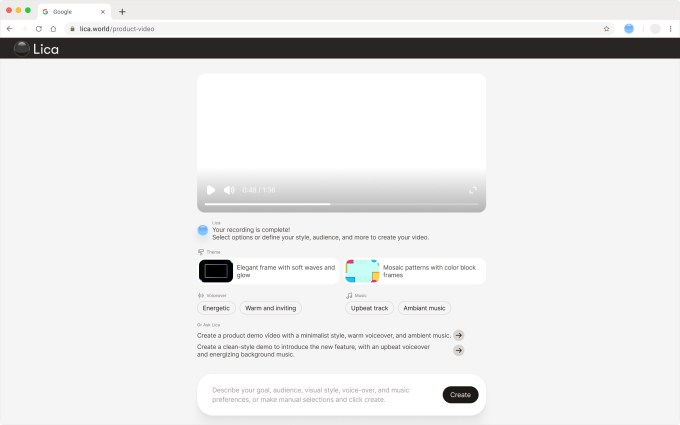
The founders note that the tool also understands design aesthetics well. In cases where the user enters an unusual design or unusual color choices, the tool makes sure that the final product looks nice and not off-putting.
Mehta mentioned that the AI assistant has two types of models: a coordinator that brings together different parts of the presentation, including choosing the best voice for narration, and a layout generator that takes care of how different parts of the screen recording or text will appear on the screen. screen. The company uses a mix of open source and close-source models for other parts like audio generation.
Lica currently has a free tier that allows you to create 10 videos with a maximum of 3 minutes each and 3 downloads per month. You can pay $49 per month to create unlimited 10-minute videos and get 10 downloads plus access to branded templates.
While the startup’s current focus is on product videos and tutorials, in the coming months Lica will look to fine-tune its AI assistant for more video formats, such as marketing, presentation, social media and investor presentations.
Lica may not have direct competitors, but companies and startups generally use anything from a Zoom call to a screen recording to create rudimentary video, using a tool like Loom to enhance it. AI-focused startups like D-ID and Synthesia have used avatars for educational videos or internal messages.
Accel’s Sameer Gandhi believes the startup has the right mix of team quality and its product approach.
“Lica differentiates itself by combining advanced AI capabilities and intuitive design into a single platform, allowing users to maintain creative control while leveraging AI-powered capabilities. Combined with the team’s innovative AI and product development background, we believe they are uniquely positioned to meet the needs of A key market that other solutions have not yet been able to fully capture,” he told TechCrunch via email.
[ad_2]