[ad_1]
On a September morning in 2024, two Jonathan Cohens — one from the Rockaways in Queens, the other from London — stood in an empty 15,000-square-foot parking garage near Hudson Yards in New York City. As they walked over the dashed yellow lines, they explained how the space will help Joco, the startup co-creating e-bikes for delivery workers, continue to expand.
“We are eliminating all cars, and will be fully dedicated to electric two-wheelers, three-wheelers, four-wheelers, and light EV charging,” Cohen (New York), Joco’s chief growth officer, told TechCrunch. .
The two were walking through the cavernous area, interrupting each other like a couple telling a story to their friends as they set the scene for a place that would be as useful as it was community-related: a mechanical shop in the back, several rooms with charging lockers so riders could swap e-bike batteries, docking stations, and two bathrooms.
Cohen (London), Joco’s CEO, pointed to an area not far from the front that will be dedicated to Joco’s concierge service, where delivery riders can check in, pick up supplies, and take a break from the chaos of the city.
“Think of it as a gas station (for delivery riders),” Cohen (New York) added. “They will use it as a place to relax and take a break.”
The concept of providing a stop for gig workers — a place to use the bathroom, charge their phones and even pray — isn’t new to Joco, which already offers the service in partnership with Grubhub at two locations in Alphabet City and Midtown West. After the company nearly folded several times in its first year, its duties of care to the customer are a big reason why Joco is still alive today.
GOCO – Named after its co-founders, who met in Columbia Business School in 2017 – Launched in 2021 in New York City with the aim of competing against Lyft-owned Citi Bike with shared and docked e-bikes. The Cohens believed that placing the Joco docking stations on private property would allow them to avoid Citi Bike land and the city’s regulatory eye. They were wrong. The New York City Department of Transportation immediately sued Joco for operating a bike-sharing service without prior permission from the agency, forcing the startup to shift away from offering consumer rides toward last-mile delivery.
Now, Joco serves both gig workers who rent e-bikes at daily or weekly rates and enterprise customers who request custom fleets from the startup. Joco has about 18 enterprise clients — including Grubhub, Reef, Fresh Direct and other large logistics companies — across New York, Chicago and Miami. As part of its B2B suite, Joco also provides fleet management technology, service and maintenance, docking stations and, increasingly, battery charging tanks.
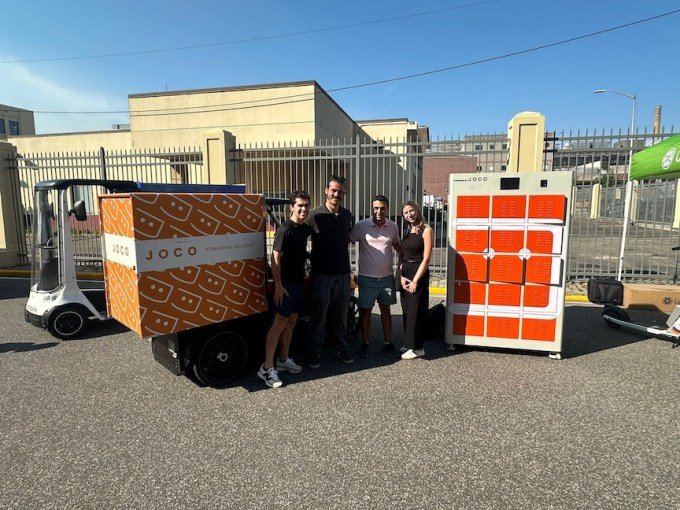
These lockers, which Jocko says are FDNY-certified, are a growing vertical for the startup, particularly in New York City where battery fires due to unsafe charging practices have become widespread, prompting many buildings to ban e-bikes and e-scooters. Joco has sold nearly 100 battery cabinets to residential buildings, such as those owned by related companies, and last-mile logistics companies, such as Travis Kalanick’s Cloud Kitchens, across the country with plans for international expansion.
From cease and desist to expanding cash flow

The Cohens say the DOT’s response was a “blessing in disguise” that helped them achieve profit — not EBITDA, or “net, net, net profitable” with “real salaries” — even though they only collected $7.5 million in venture capital funds. Other similar hardware-as-a-service startups have raised multi-millions – and even billions – in venture capital, and many have folded due to high capital expenditures and the low-margin nature of the business.
“It forced us to focus,” Cohen (London) told TechCrunch. “That’s the lesson we came to too quickly, inadvertently. The other lesson we learned is to really care about the customer. Because we’re crazy about our customers. Just this Sunday, we had a guy whose bike broke down in Queens, so I rented a car, went over there, I picked up his bike and took him back to another station in Manhattan.
He continued: “When our customers see this, they panic, and they tell everyone.” “We do extraordinary things for customers, things they don’t expect.” Cohen (London) noted that some of these decisions on the face of it did not necessarily have a “financial rationale” but had created customer loyalty.
Concierge service—which involves having several employees on-site to help meet the needs of delivery riders—is an example of this. Joco is also giving away free bike helmets, vision vests, hand warmers, and, through a partnership with Grubhub, free temperature-controlled backpacks.
There are other startups offering e-bike rentals via courier. Whiz and Zomo come to mind, but they offer long-term rentals where the delivery person has to store and lock the bike and charge the battery. With Joco, gig workers have access to high-quality e-bikes at an affordable cost and never have to worry about locking them or carrying them up the stairs — riders can lock and unlock the bikes using an app — a small but powerful convenience when making deliveries all day long.
“We make a lot more money per bike than another company where you rent the bike and take it home for a month because we have multiple people using the same vehicle, delivering around the clock,” Cohen (London) said. Noting that the life cycle of new Segway bikes ranges from three to five years.
There also seems to be a quiet community among Goku Riders. Workers picking up bikes from the Alphabet City concierge can be seen chatting and bumping their fists, and when they catch up with another Joco rider on the streets, they often wave and say hello to each other.
Goku’s customer obsession is clearly evident in growth. This empty parking garage? Fast forward two months later, and it’s now almost open for business, with 1,000 new Segway e-bikes and 1,000 more on the way. This location is one of about 50 docking stations, large and small, accessible by couriers throughout the city. The Cohens say this is still not enough to meet the demand for their services.
“Every one of our cars is used every day,” said Cohen (New York), noting that Joco has “spent $0 on marketing” since its launch. He says the team has been able to grow the company’s headcount by double digits every month mainly through word of mouth.
This is one of the Cohen family’s tips for early-stage founders: Don’t spend your money on marketing too early in an attempt to attract attention and raise capital. Just put your head down and focus on execution. That’s how the two said they got to where they are today, with cash flow funding their expansion, rather than investment money. For them, “founder mode” is essential, because it means always being available to roll up your sleeves, even on Thanksgiving and Christmas or at 3 a.m.
“Like when we switched from the old Acton bikes to these Segways, it was fun all night long,” Cohen (New York) said.
Jocko still runs a lean ship, with about seven people on the company team. In total, they have about 50 employees in maintenance, call center, operations, warehouse management, software and supply chain. Many of these teams are outsourced to employees outside the United States, which the co-founders say saves them money as they work to grow the business. They also hire part-time employees, such as a CFO, which is a good strategy for early-stage startups that want to hire an experienced executive on a part-time basis.
This financial prudence is what will help JoCo expand in 2025. The founders said their near-term growth plans come from cash on hand and perhaps some debt, but they do not intend to raise more equity.
Their goal for next year is to grow Joco’s fleet of workers from 3,000 today to 10,000 by the end of 2025 and build new docking stations in Brooklyn and Queens. Joco also wants to get 1,000 on-premises battery charging lockers and double its B2B footprint in the next 13 months, partly by bringing more four-wheeled charging bikes to its lineup.
And Goku has some tailwinds at his back, especially in New York City where A.J Congestion pricing plan It is scheduled to take effect in January.
“There will be more opportunities for us to get garage space at better prices,” Cohen (New York) said. “You don’t need a two-tonne vehicle for short delivery commutes. So the more we can do to build the infrastructure and technology, the more convenient it will be for commuters.
[ad_2]